
Find People Through San Leandro Records
Choose a starting record by what is already known. A street address works best in the Alameda County Assessor Property Search, which accepts parcel or address input. A full name can lead to recorded instruments, civil or probate cases, city staff listings, business filings, or a professional license. A school year or approximate death date makes the San Leandro History Room more useful than a current online portal. Phone numbers work chiefly in public agency and institutional directories, not in a government resident database.
San Leandro people search results must be joined with care. A shared name is not proof that two files concern the same person. Compare dates, middle names, parcel numbers, case types, business addresses, and family ties. Official indexes point to records, but an index entry may not show the full document or its later corrections.
- Write down the known name, date range, address, school, business, or record type.
- Search the custodian whose index matches that fact, such as the assessor for an address or eCourt for a party name.
- Open the underlying record or request a copy. Do not treat a search-result line as the whole file.
- Cross-check one independent source, such as a deed, obituary, yearbook, or business filing.
- Use the counter, mail, library, or public-record request channel when the web coverage ends.
San Leandro Records Office Map
San Leandro is not the Alameda County seat. Most durable identity records therefore point to Oakland. The Clerk-Recorder keeps official documents, vital certificates, fictitious business names, and marriage services. The Assessor keeps the public assessment roll and parcel maps. City Hall handles municipal files such as ordinances, permits, agreements, police-record requests, and staff contacts. The detailed access rules belong with San Leandro public records, but the office split is the first fact to get right.
Call the office before a counter visit when a search depends on old books, microfilm, a certified copy, or a restricted file. The portal and the public counter may expose different parts of the same record system.
Alameda County Clerk-Recorder
1106 Madison Street
Oakland, CA 94607
510-272-6362
San Leandro City Clerk
835 E 14th Street, 2nd Floor
San Leandro, CA 94577
510-577-3367
San Leandro Recorder Search Cutoff
The Alameda County Clerk-Recorder Web Access index covers official records from 1969 forward. Earlier deeds and instruments require an in-person search at the Oakland office. That clean cutoff explains why an old San Leandro ownership trail may stop online even when the underlying record still exists. The public entry screen requires a disclaimer acknowledgement and offers quick date ranges. Its deeper search form is dynamic, so field labels not verified in the research should not be assumed.
The index is a finding aid. A plain copy costs $3.50 per page. A certified official-record copy costs $4.50 for the first page and $3.50 for each added page. Most counter requests are completed at the time of payment, while large orders may need one to three business days. Printing stops late in the afternoon, so timing matters for an in-person visit.
The official Web Access entry screen shows the county disclaimer and portal entrance used for current San Leandro records.
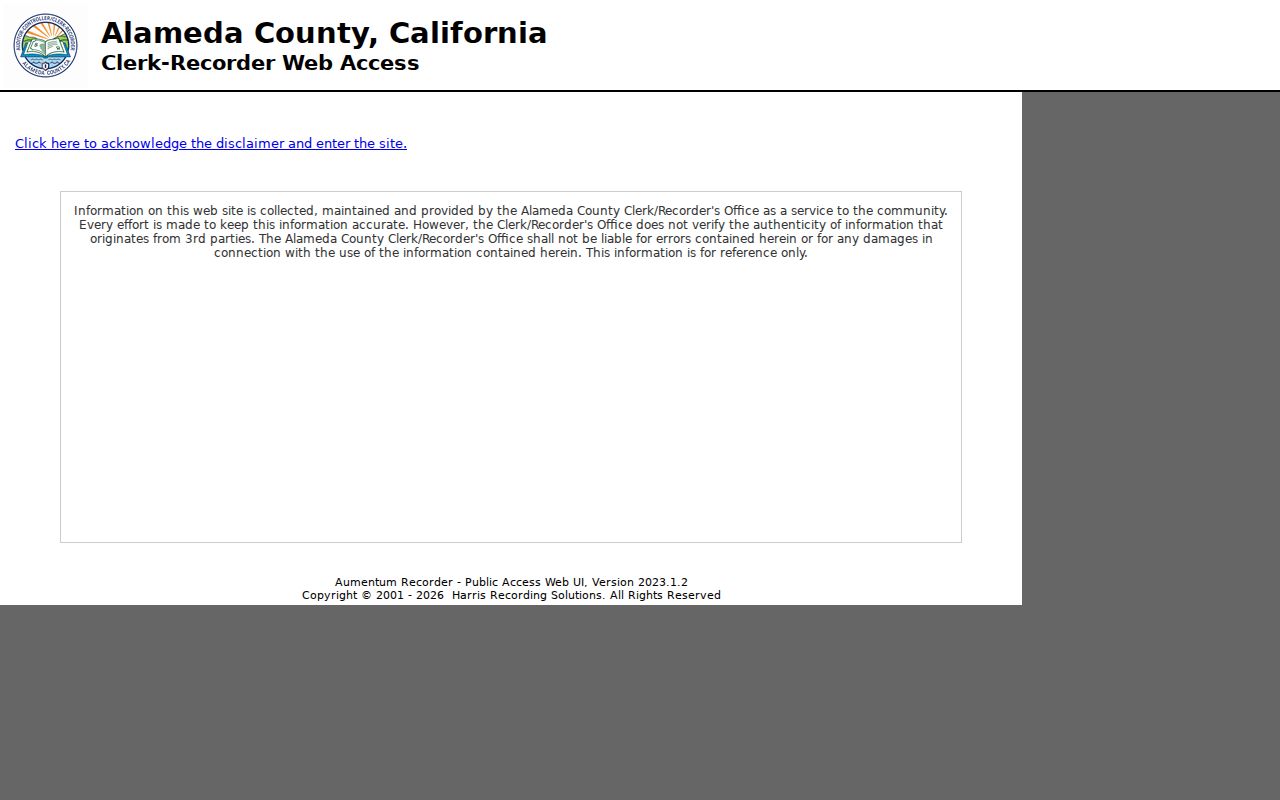
The screen is only the web front door. Records dated before 1969 still send the searcher to the Clerk-Recorder counter.
Note: An online cutoff marks the limit of the index, not the loss or destruction of the older record.
Trace San Leandro Property Owners
Property research works in two directions. Start with the Assessor when the address or parcel number is known. The public assessment roll includes an Assessor's Parcel Number, owner name, property address, assessed values, exemptions, tax rate area code, use code, and parcel maps. Yet the public web screen inspected is keyed to a parcel or address, not an owner name. A name-first inquiry may need public roll access through the office rather than a claim that the web tool can do more than it shows.
| Search option | Input | Best use | Limit |
|---|---|---|---|
| Parcel Number | APN, such as 123-345-67 | Open one known parcel | Needs the county parcel key |
| Type Ahead Address | Suggested street address | Resolve an address as typed | Depends on a matching suggestion |
| Property Address | Street address | Find a parcel from a location | No owner-name field was verified |
Once the APN is known, compare the assessment roll with recorded deeds and the geoSL parcel dataset. geoSL says Alameda County maintains parcel attributes such as APN, site address, and lot size. For a past occupant, add History Room directories and newspapers because an owner and a resident are not always the same person.
Address labels also need context. A situs address marks where the parcel sits, while an owner's mailing address can be elsewhere. The captured public text did not prove that a mailing address appears on the web parcel card, so it should be verified through the Assessor or tax office rather than assumed. San Leandro ZIP codes also touch unincorporated and neighboring areas. A San Leandro mailing label does not, by itself, establish that the property is inside city limits.
Search San Leandro Court Records
The Alameda eCourt Public Portal covers civil, family, probate, mental health, and adoption portal categories. Users register for an account. A paid Name Search returns matching case numbers and filing dates, with the first 1,500 cases displayed. Selecting a case opens its register of actions, which is the dated list of filings and court activity. Up to ten cases may be viewed for a searched name before another name credit is needed.
Criminal, juvenile, and traffic matters are not in that eCourt search. Non-confidential criminal copies use the Superior Court's separate request route. Juvenile, sealed, and other protected files may not be open at all. Federal matters use PACER for the Northern District of California. Probate can be especially useful in family and estate research because public case material may connect a decedent with petitioners, heirs, creditors, or fiduciaries.
| Record system | Included matters | Name route | Access condition |
|---|---|---|---|
| Alameda eCourt | Civil, family, probate, mental health, adoption | Paid Name Search | Account and search credit |
| Alameda criminal requests | Non-confidential criminal documents | Separate request channel | Not in the eCourt name page |
| Northern District of California | Federal cases | PACER party search | Account and federal fees |
- Case number
- The court's identifier for one case.
- Register of actions
- A chronological list of filings and court events.
- Certified copy
- A copy formally authenticated by the record custodian.
San Leandro Vital Records Paths
The Alameda County Clerk-Recorder is the local certificate counter for county births, deaths, and marriages. California Department of Public Health Vital Records is the statewide custodian for birth, death, fetal death or stillbirth, marriage, and divorce record functions. Divorce decrees come from the Superior Court where the case was filed.
California uses authorized and informational copies instead of a simple modern-record cutoff. Health and Safety Code section 103526 governs who may receive an authorized certified copy. That request needs an eligible relationship and sworn statement, with notarization generally required for an authorized copy requested by mail. Others may be able to receive an informational copy marked as not valid to establish identity. Alameda County's 2026 certified-copy fees are $36 for birth, $28 for death, and $21 for marriage.
Genealogy follows a separate trail. The California State Archives lists Alameda County marriages from 1854 through 1955 on microfilm, while the local History Room supplies newspapers, directories, yearbooks, and obituary research that can identify relatives and event dates.
Search San Leandro History Room
The San Leandro History Room is the strongest local source for people who lived here before modern web portals. It holds Hayward and San Leandro city directories from 1925 through 1965, local middle and high school yearbooks from 1933 to the present, Alameda County census data from 1852 through 1920, more than 2,200 historical photographs, Sanborn fire insurance maps, newspapers dating to 1856, and clippings from the 1960s forward.
These sets answer different questions. Directories can connect a resident with an address and, depending on the year, an occupation or spouse. Yearbooks locate classmates, teachers, clubs, and teams. Newspapers can supply marriage, death, probate, business, and civic details. A directory volume may be cataloged under Hayward as well as San Leandro, which is worth remembering when a local surname seems absent.
The library also accepts obituary research requests. Give the date of death or at least the month and year, and use the requested email subject line, "Obituary Request." A narrow time anchor lets staff search a newspaper run without guessing across decades.
Early research may require older geographic labels. Alameda County was created in 1853, and residents connected with Rancho San Leandro or Eden Township can appear in county land, probate, naturalization, census, and marriage material instead of a modern city index. The State Archives local-government inventory includes Alameda County marriage records from 1854 through 1955 and broader county record groups. Begin with a likely year and place because some microfilm lacks a name index. Then use the History Room to bring the county record back into local context through maps, directories, school records, or newspapers.
San Leandro Business Identity Records
A business name can bridge to an individual through several official layers. The San Leandro business license lookup searches by business name or address. Alameda County fictitious business name records connect a trade name with its registrant and mailing address. California's bizfile Online covers corporations, limited liability companies, and limited partnerships, with public filings that may show an agent, address, status, and managers or officers depending on entity type.
Use the record that fits the entity. A local license confirms city activity. An FBN, often called a DBA, identifies a name used by a person or business that differs from the legal name. State entity filings track corporations and LLCs. California's statewide consumer-affairs license search verifies many regulated licenses and can show whether a credential is current, expired, suspended, or revoked.
Accuracy point. Alameda County FBN filings made under the rule effective in 2024 use a business mailing address rather than the registrant's residence address.
San Leandro Custody Record Lookups
The Alameda County Sheriff's Inmate Locator accepts a PFN, or a first and last name. It also offers middle name, sex, date of birth, a phonetic spelling option, and human verification. Its "Pending Release" status applies to people at Santa Rita Jail and Glenn E. Dyer Detention Facility who have entered the release process. It does not promise that release will occur, since another legal hold may be found.
State custody is separate. California's incarcerated-person search can return a name, CDCR number, age, present location, commitment county, admission date, and certain parole-hearing information for people currently in state custody. The California Megan's Law Website displays only information that Penal Code section 290.46 permits. Some registrants appear by address, some by ZIP Code, and others are not publicly posted. It is a safety resource, not a general address book.
Restricted San Leandro Voter Records
California's My Voter Status tool lets a voter check personal registration details, party and language preference, ballot status, polling place, election information, and county contact information. It is not a public resident directory. A full California voter file requires an approved statutory purpose, a signed application, identification, a fee, and a use agreement. Driver license and state ID numbers, the last four Social Security digits, unique identifiers, and signatures remain excluded.
Confidential voter records and records for protected pre-registrants are also withheld. The complete rules, file formats, fees, Safe at Home protections, and request steps are treated end to end in the San Leandro voter records lookup.
Use voter information lawfully. California limits voter data to approved purposes, and Elections Code section 18109 makes knowing misuse a misdemeanor.
Request San Leandro City Records
City records have more than one access channel. Laserfiche WebLink carries agenda packets from November 2006 forward, minutes and ordinances from 1996, resolutions and agreements from 2000, minute orders from December 2006, and selected recorded documents from 2005. Accela Citizen Access searches permit histories and code-enforcement records. The GovQA Public Records Center receives requests for files not found in those databases.
The city accepts requests in writing, by fax, by mail, or verbally, though a written request helps define the records sought. California agencies generally have ten days to determine whether they hold disclosable records, with a possible fourteen-day extension in unusual circumstances. That is a determination period, not a promise that every responsive document will arrive within ten days.
The city's Public Records Online page explains these distinct search and request routes.
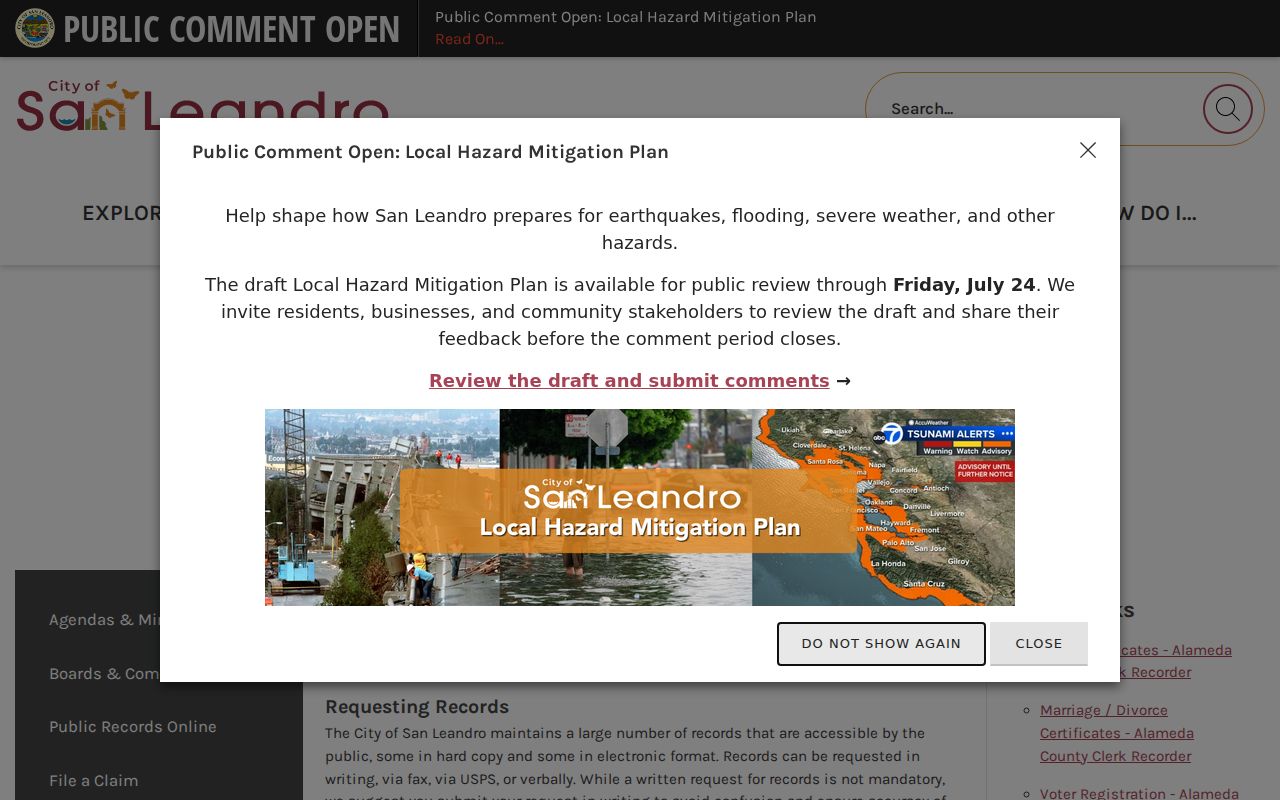
The page separates ready-to-search electronic files from records that require a formal city request.
Search Safely in San Leandro
Official access does not erase legal or personal limits. Do not use a public record to stalk, harass, threaten, or harm anyone. Verify a result before acting because names repeat, indexes change, and a recorded document may preserve old information. Commercial data deletion is a separate issue from government records. California's DROP platform and Delete Act concern registered data brokers, not deeds, court files, assessment rolls, or lawful custodian archives.
Property owners have a local safeguard. Alameda County promotes recording-activity alerts and the free Property Fraud Alert service. An unexpected notice should be checked with the county using official contact information. The State Controller gives similar advice for unclaimed property: the official claim process has no fee and no deadline once the state holds the property.
San Leandro Records Beyond Portals
No single portal holds a complete San Leandro people search. Online recorder access stops at 1969. The assessor's public screen begins with an address or parcel. Criminal court records use a route outside eCourt. Vital certificates require the right copy application. Restricted voter information requires eligibility. Each limit has a documented fallback: an office counter, a mail form, a separate request channel, the State Archives, or the local library.
| When the web stops | Next official channel | What to bring |
|---|---|---|
| Deed predates 1969 | Oakland Clerk-Recorder counter | Names and an approximate date |
| Owner-name search is unavailable online | Assessor public roll or office | Name, address, or APN |
| City file is absent from Laserfiche | GovQA or written city request | A focused record description and date range |
| Past resident predates current databases | San Leandro History Room | Address, school year, or death month and year |
A strong result is often a chain, not one hit: address to parcel, parcel to deed, deed to a prior name, then directory or obituary material that supplies the human context.